
Top 5 misconceptions about AI
Length:
8 min
Published:
June 18, 2025
More people use artificial intelligence every day. ChatGPT alone has around 122 million daily users. Even so, a lot of inaccuracies and assumptions still surround AI.
In this article we look at them up close. Which misconceptions about AI do we run into most often?
1. Artificial intelligence = ChatGPT and other LLMs
Most people meet artificial intelligence through ChatGPT and other language models (LLMs). But that is only one of many types of AI.
LLMs are a small slice of a huge field. Calling them the whole of AI is like saying the internet is email.
In reality, AI covers a much wider range of technologies, and you have probably already met several of them. Here is a selection.
Machine Learning
Computers learn from data without anyone programming them step by step. Models learn to recognize patterns, relationships, and rules that are not obvious in the data at first glance, so they can predict, classify, and decide even on new information.
Examples: disease prediction, risk assessment in banking, customer data analysis, weather forecasting.
Computer Vision
It recognizes and analyzes images and video.
Examples: face detection, license plate recognition, X-ray analysis, OCR (reading text from an image).
Reinforcement Learning
The model learns the best behavior by trial and error. It collects rewards for good moves and penalties for bad ones, in a dynamic environment.
Examples: AlphaGo, robot control, AI in games, traffic control.
Generative Models
They create new content.
Examples: DALL-E (images), Sora (video), Suno (music), ElevenLabs (voice), Veo 3 (video).
Recommender Systems
They recommend content based on how a user behaves.
Examples: Netflix, Spotify, YouTube, e-shops, and social networks such as Facebook or Instagram.
2. AI = search engine
Many people use AI the way they use Google. They ask a question and wait for an answer. That creates the impression that AI is just a "smarter search engine", when in fact these are completely different technologies.
A search engine like Google searches the internet in almost real time. Most AI models, such as ChatGPT, instead generate answers from data they learned in advance, and by default they do not look up current information. Some versions, like GPT-4o with web browsing, do have online access, but it is neither automatic nor universal.
The energy cost differs too. Generating an AI response is, depending on the model, orders of magnitude more demanding on computing power and energy than an ordinary search.
The line between AI and search is starting to blur. Google, for example, wires Gemini straight into its search results. It is still two different technologies working together.
3. Automation = AI
Lately a lot of classic automation gets mistaken for AI. But automation and AI are not the same, even if they sometimes overlap. You can handle plenty of routine tasks without AI; automation is enough. Tools like Make or Zapier can help with that.
Automation means the system runs predefined steps without a person, following fixed rules. It doesn't think and it doesn't learn; it just repeats what it was told. A good example is the confirmation email you get after a purchase: when A happens, do B.
Artificial intelligence, on the other hand, learns from data, adapts to new situations, and can make decisions that were never programmed in advance. Take that same confirmation email, except the content adapts to your behavior. The AI might pick product recommendations tailored to you.
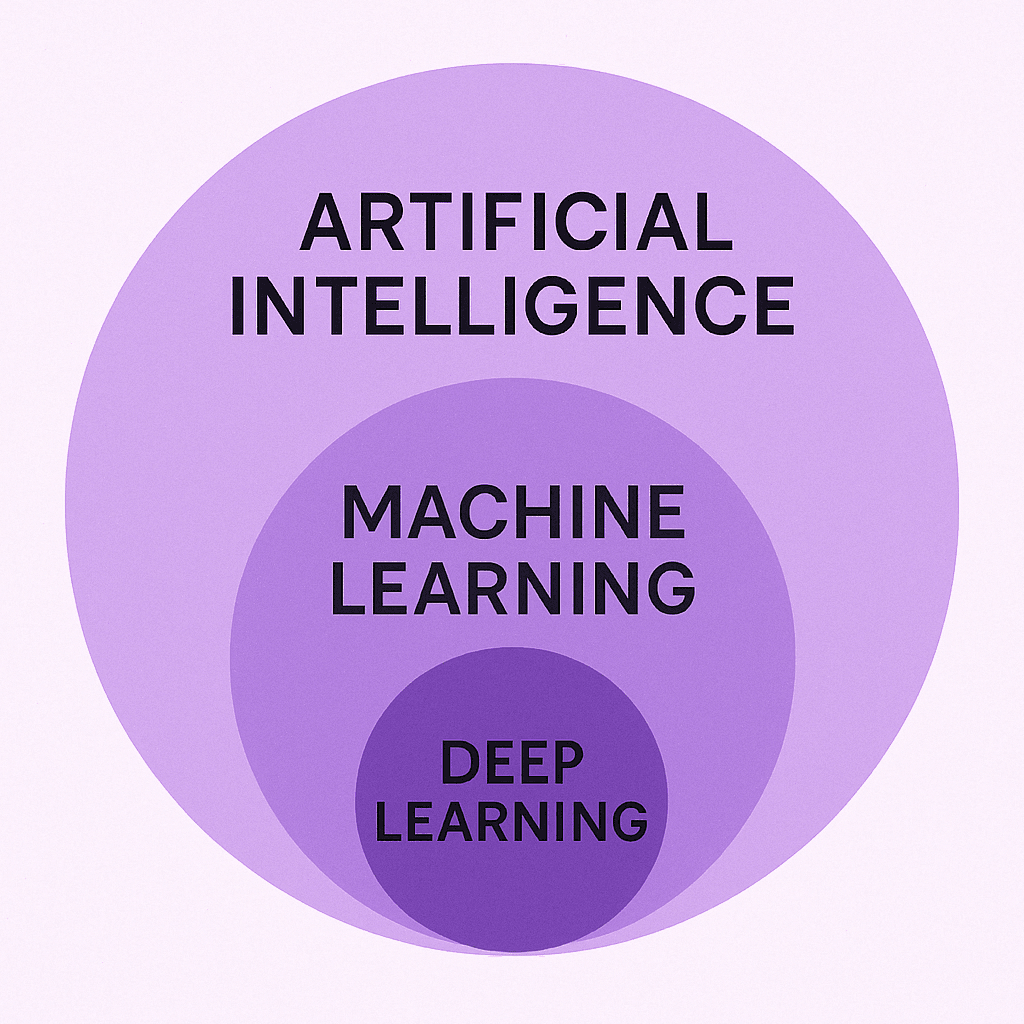
4. Machine learning = AI = deep learning
These terms often get confused:
- Artificial intelligence (AI) is the broadest term. It covers systems that solve problems and automate tasks that usually require human intelligence.
- Machine learning is a subset of AI. Models learn from data instead of being programmed by hand.
- Deep learning is a subset of machine learning. It uses deep neural networks to recognize complex patterns in data on its own.
5. AI has its own opinion
When AI answers fluently and confidently, it can look like it holds an opinion. It holds none. It has no consciousness, no values, no convictions.
AI responses are the result of a calculation that predicts which words fit best statistically. It does not express intent, attitude, or a personal view.
The fact that something sounds human doesn't make it human.
Conclusion
AI is still surrounded by plenty of inaccuracies, and there are far more than the ones we listed here. It is an exceptionally capable technology that we are still learning to use. Much like we once learned to use the internet.
It has huge potential, but it also has limits, and those are worth knowing. That is why it pays to understand what AI really is, what it can do, what it can't, and what we might only assume about it.
Related articles:
- TL;DR of the most commonly used AI terms - Getting lost in the terminology of the AI world? Then this article is for you.
- AI: Assistant or threat to juniors? - AI in development through the eyes of a junior: a valuable helper or an invisible crutch that hinders growth?
- How to know when the time is right to implement AI? - A practical guide for companies that are considering using AI but are still hesitant.
- The ecological impact of AI: What's going on behind the scenes? - Using AI is not without impact - every prompt triggers processes that consume both electricity and water.
Want to stay one step ahead?
Don't miss our best insights. No spam, just practical analyses, invitations to exclusive events, and podcast summaries delivered straight to your inbox.