
DX Heroes AI Platform
From one process to dozens.Without hiring.
AI agents read your documents for you and write them into your systems. You decide what they may touch and where they run, and you have a record of every step.
Runs on your servers or in a European cloud
Start with one process
Nothing gets rebuilt
We built it for our own operations. Today it also runs at customers in regulated environments.
Sample
One step of an agent
From manufacturing
An inquiry arrives by email as a long PDF with pictures and notes.
The agent reads the attachment and extracts over 30 parameters.
It sorts the items by the company's standards and rules.
A technician checks the result and approves it.
The inquiry goes to pricing. Every step is on record.
The inquiry waits for someone to free up. Your customer does not.
Company knowledge lives in documents: contracts on SharePoint, PDF orders in inboxes, drawings, spreadsheets. People carry it into systems by hand, and the whole queue waits for them.
Customer
Before the inquiry gets its turn, the customer orders elsewhere.
At one manufacturing site an inquiry waited two weeks for an answer, and only part of the queue got handled. An example from production, not a guaranteed result.
Operations
People retype documents instead of doing the work they are good at.
A technician, an accountant or a salesperson reads a PDF and copies numbers into the ERP. When that person is out, the work stops.
Security
Nobody knows what AI tools do in your company.
People connect their own AI tools to company data. An overview of who uses what usually appears only after an incident.
Same documents, same systems. A different speed.
Today
The bridge between documents and systems is human hands.
SharePoint & document stores
Inboxes with PDF orders & invoices
Scans & technical drawings
Spreadsheets
People read, retype, forward
Your systems (ERP such as SAP)
SharePoint & document stores
Inboxes with PDF orders & invoices
Scans & technical drawings
Spreadsheets
People read, retype, forward
Your systems (ERP such as SAP)
With the AI Platform
A document gets through in minutes, and every step leaves a record.
SharePoint & document stores
Inboxes with PDF orders & invoices
Scans & technical drawings
Spreadsheets
Agents
read, extract, answer, enter data
Control layer
access, policy, audit trail
Your systems (ERP such as SAP)
Audit trail
what they did, what it cost, whether it helps
SharePoint & document stores
Inboxes with PDF orders & invoices
Scans & technical drawings
Spreadsheets
Agents
read, extract, answer, enter data
Control layer
access, policy, audit trail
Your systems (ERP such as SAP)
Audit trail
what they did, what it cost, whether it helps
Others bring the bricks. We help you build the whole thing.
We don't ship a box. We assemble a concept that fits your company, out of parts you can swap.
No lock-in
The components are swappable.
You pick every part, ours or somebody else's. Change your mind later and you replace one part, not the whole build. You are never locked in with a vendor.
Fitted
A concept shaped around your company, not a package off the shelf.
We assemble it around your processes, your systems and what your data allows. You start where it makes sense to you.
What it is not
Not a chatbot over documents, and not a service in a foreign jurisdiction.
We built it for our own operations in Prague, and today we deploy it at companies in the Czech Republic and Slovakia.
Ten processes without a shared layer is ten times the risk.
The agent reads, extracts and writes. You approve the exceptions.
The DX Heroes AI Platform gets your documents into your systems without retyping. Agents read, extract and write them; you decide what they may touch and where they run, and you have a record of every step. From one process to dozens. Safely, and without hiring.
A document arrives
By email, into a shared folder or from a scanner. Nothing changes in how you receive it, so there is nothing to rebuild.
The agent reads and extracts it
Items, parameters, amounts. Unclear cases get flagged and handed to a person, so nothing slips through.
It passes through the control layer
Access, rules and the record live in one place. The agent touches only what it may, and you can show it at any time.
Written into your system
Approved data goes into the ERP or wherever you need it. Your customer gets an answer the day they ask.
What you get
Documents handled the day they arrive. At one site every inquiry got handled instead of part of the queue, and the win rate moved from just under five percent to six. An example from production, not a guaranteed result.
A record of every step. When the auditor asks, you answer from records, not from memory.
Data under your control, on your servers or in a European cloud.
Agents don't take people's jobs, they take their activities. The technician who used to handle documents by hand now runs the automation and approves the exceptions.
What you need for it
Read access to the systems the work touches. Nothing gets rebuilt.
A decision on where it runs: your servers, or a European cloud.
One person on your side who owns the topic.
A first process to pilot. A pile of PDFs is the usual start.
It already runs in manufacturing. It started with a pile of PDFs.
From manufacturing, where it is proven
Inquiries
Inquiries sorted for the technicians
Inquiries arrive by email, sometimes as hundred-page PDFs with pictures and handwritten notes. Technicians used to sort them themselves.
An inquiry arrives by email, often as a long PDF.
The agent sorts the items by standards and company rules.
A technician reviews the worksheet; the agent learns from corrections.
The checked inquiry goes straight to pricing.
>99 %
sorting accuracy, 30+ parameters per inquiry
Read the case study →
Quality control
Products checked against the drawing
A technical drawing sets how far each dimension of a product may deviate.
The input is a drawing with tolerances and a measurement report (PDF).
The agent matches measured values to the drawing's dimensions.
It compares every deviation with the allowed tolerance.
The report flags defective pieces before they move on.
Sensitive drawings must not leave the company, so the agent runs on models operated in the Czech Republic.
In other industries
Knowledge
Answers from your SharePoint
An assistant answers from the documents you already keep on SharePoint and network drives. Every answer links to its source and respects access rights. People find the document in seconds.
Orders
Orders in the system the same day
Customers send orders by email in dozens of formats. The agent reads them and writes them into the ERP; a person confirms only the unclear ones. An order lands in the system within minutes, not whenever someone gets to it.
AI rollout
An AI assistant for the whole company, not a handful of people.
When a hundred people get an AI tool, it is not enough for each of them to set up their own connection to Slack or other company tools. Through the control layer, everyone connects under their own identity and IT manages one connection instead of a hundred.
Agents don't take people's jobs. They take their activities.
The change does not happen through technology, it happens through people. So we talk about it straight, and from the start.
The job
A job is made of activities.
Open the email, work out whose it is, move the data into the system, decide the exception. The agent takes over the activities that repeat.
The space it frees
The space that frees up goes into work a machine cannot do.
Decisions, exceptions and dealing with the customer stay with people. That is where value is made, and where you need them most.
A new role
A new role appears: the operator of the automation.
Someone runs it, checks its output and approves the exceptions. It is a job for the people you already have, once you prepare them for it.
Without new job descriptions and retraining, the process does not get rebuilt.
The road to a platform starts with one process.
We don't start with a platform. We start with a process that pays for itself, and every step builds on the one before it. You move only as fast as you want to.
Trust
We walk your operation and show on a small example that we understand it. No commitment.
First use case
One process, usually a pile of documents. We pick the one that brings money in, not just an hour saved.
Training
Workshops for the people in the process and for management, so everyone knows what they may and may not do.
AI adoption
AI in daily work, not in a pilot. We measure who uses it and whether it helps them.
Data for AI
You let agents reach your data under the identity of a named person. An agent sees what your employee sees.
AI platform
The control layer: identity, rules, a record of every step and a view of the spend. Quiet for your IT and security.
Scaling
Ten processes instead of one. Each next one costs less, because the connections and the rules already exist.
Why not start with the platform
What we build first is already part of the platform.
The first application uses the same identity, the same records and the same connections as everything that follows. When you add a second and a third process, nothing gets thrown away.
We don't sell what we don't run ourselves.
We built it for our own operations in Prague. Beyond that, the core of the platform runs in production in regulated environments: two companies in the Czech Republic and a bank in Slovakia.
6 billion
tokens processed across our AI tools in 30 days
100
AI-eNPS of our team, measured by AI Pulse
Our own numbers from a small company, not a benchmark. The platform collects and renders them itself.
„Six billion tokens a month is not a marketing number, it is real production traffic. And that is exactly the measurement most companies are missing when they decide about AI.“
Vratislav Kalenda Founder, Applifting
The numbers above are ours. Yours start with a pilot.








The agent works. You decide, and you have it on record.
Runs on your servers or in a European cloud.
Configuration, access and records stay in your databases.
Access without handing out keys.
The agent gets limited access to what it needs. When someone leaves, you revoke everything in one place.
A record of every step.
You can show at any time who touched what with AI. Records also flow into your security monitoring (SIEM).
Sensitive documents never leave the company.
Where the job requires it, the agent runs on models operated in the Czech Republic.
Data about people only in aggregate.
Measurement serves teams and their growth, not the evaluation of individuals. You control access and retention.
EU AI Act with evidence in hand.
An inventory of tools, an audit trail and reporting per team. We supply the evidence; leave the reading of the obligations to your lawyer.
The agent may do only what you allow.
A person runs the pilot, not a ticket.

Prokop Simek
CEO
Leads the first meeting and the pilot proposal. Makes sure the chosen process pays off.

Jakub Vacek
Applied AI Architect
Designs the agents and takes them to production. Deploys the platform at your company and hands it over to your IT.
For your IT and security
From here down we answer how the platform is built and how it holds up in a security review.
A reference architecture in six layers.
Top to bottom: where people work with agents, what the agents can do, where every call passes through, how the platform reaches your systems, and where all of it runs.
Layer 1
Interfaces for people
Where people talk to agents. The channels you already have, plus screens of your own.
Your app's own UI
operator panel, web, mobile
Chat and agent runtime
one chat across all processes
Teams, Slack, Copilot
Copilot can call the platform and get the answer back
Layer 2
Agent applications and knowledge
What the agents do and what they draw on. The source of truth stays in your systems.
Agent applications
inquiry triage, complaints, orders
Knowledge base and RAG
a view over your data, linked back to the source document
OCR and extraction
paper, scans and drawings into structured data
Your own applications
built by your people, in a sandbox outside production
Layer 3
Control layer
The five components of the platform. Every agent call passes through here.
The five components of the control layer
Each one deploys on its own, in whatever order makes sense to you. They share one data layer, so they add up.
Access
DX HeroesAccess under a person's identity
An agent acts under a named person's identity, and only where that person may go. Nobody hands anybody a password or a key.
A credential vault encrypted with AES-256-GCM, with automatic token refresh.
Per-user connections: everyone authorises only their own accounts. When a person leaves, the agent's access leaves with them.
GitHub, Slack, Jira, Notion and more today; Microsoft Entra or SharePoint we set up during rollout.
Control plane
DX HeroesDX MCP Gateway
Every AI tool call runs through the control plane and follows your rules.
Team profiles and per-user connections: one connector for the whole company, everyone under their own identity (OAuth 2.1, DCR).
Every tool call recorded, exported via OpenTelemetry and into your SIEM.
Self-hosted on Docker Compose, Kubernetes or OpenShift; wraps a system without an AI connector through its OpenAPI specification.
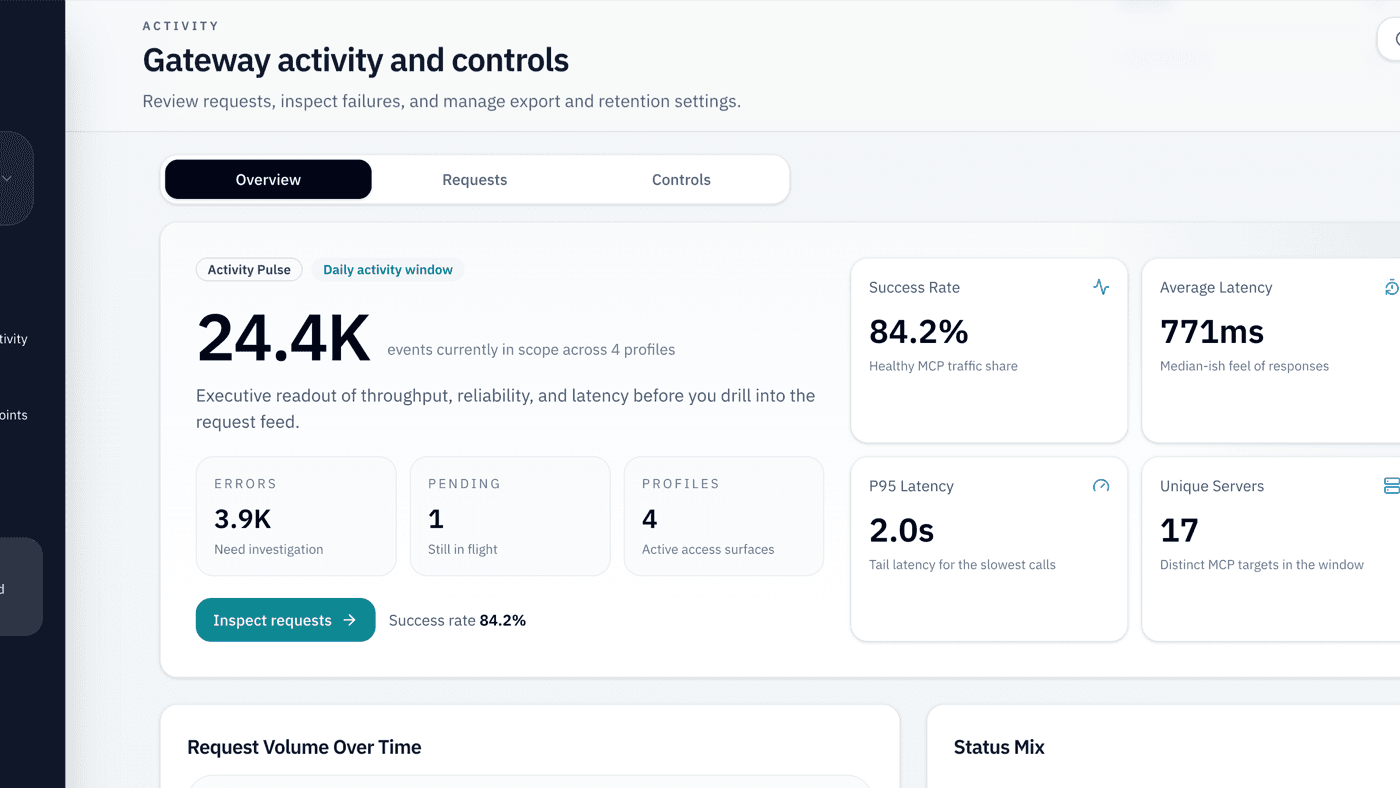
One readout of MCP traffic health for platform and security teams.
Control plane
AI Gateway
Queries to language models follow the same rules as actions in your systems.
Provider keys stay in the gateway, not on laptops.
Token spend and model usage visible per team.
Part of the platform rollout, not a separate DX Heroes product.
Insight plane
DX HeroesAI Telemetry Hub
One dashboard for what AI costs and whether it pays off.
Collects from the tools teams already use, with no agents on laptops.
Adoption funnel: who has access, who uses AI and who is a power user.
Open source (MIT), metrics with five-year retention in your perimeter.
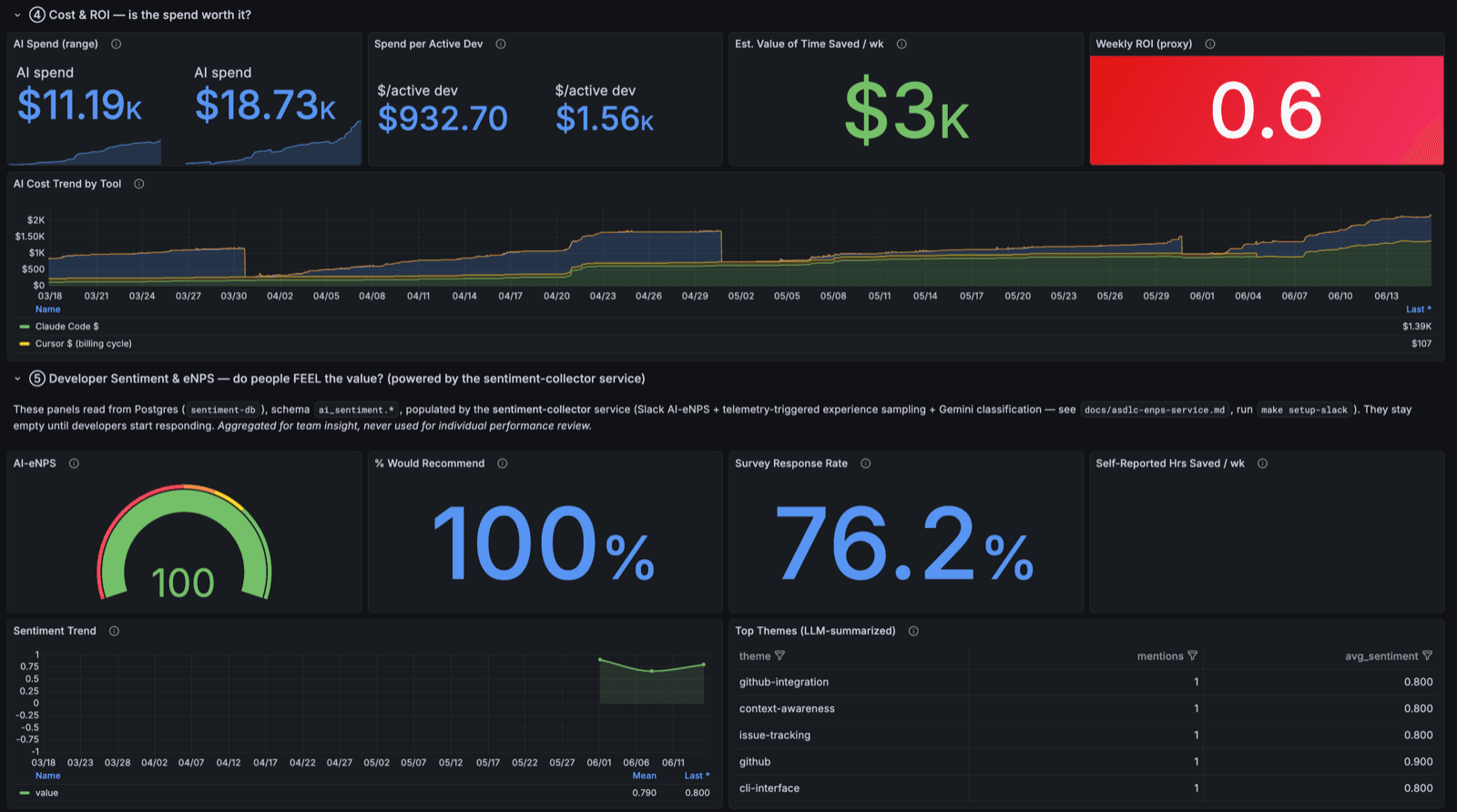
Cost and ROI next to sentiment: our own internal data, measured by the platform itself.
Employee sentiment
DX HeroesAI Pulse
Numbers show usage. AI Pulse shows whether it helps.
Short Slack questions driven by real activity, with limits so nobody gets flooded.
eNPS, themes and an estimate of hours saved, summarised by an LLM.
A team-level summary, never an evaluation of individuals.
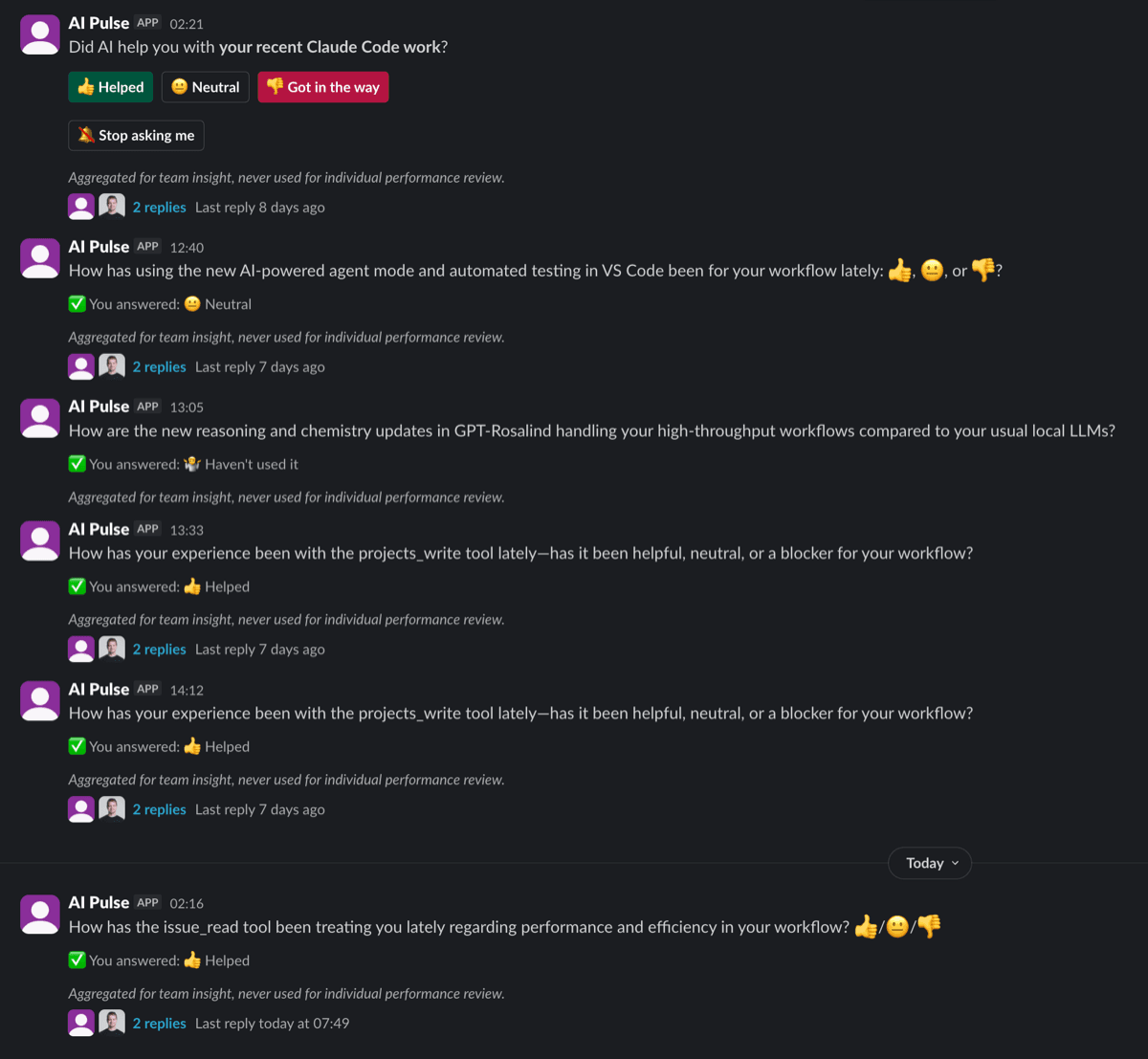
A short question in Slack, answered with one click. That is the entire survey.
Layer 4
Integration
How the platform reaches your data. Without it, the first application gets a key directly and nobody sees what it does with it.
Thin MCP adapters
over your business services
Internal integration layer
direct API for applications, MCP for agents, both governed by identity
Layer 5
Your systems and models
What you already run, plus models picked for what your data allows.
Internal services and databases
ERP, SharePoint, manufacturing and warehouse systems
External services
the SaaS you use today
Models
local, on-premise, European or global
Layer 6
Infrastructure
Where it physically runs. Your servers, or a European cloud.
Your servers or a European cloud
Docker Compose, Kubernetes, OpenShift
Sandbox for experiments
separate from production, with records and oversight
How it differs from what you may already be considering.
A regulated European company usually shortlists four kinds of alternatives.
Hyperscaler | US SaaS | Sovereign EU | DIY | DX Heroes | |
|---|---|---|---|---|---|
Runs in your perimeter | partial vendor-run control plane | does not meet US jurisdiction | meets | meets | meets |
Governance across clients & servers | partial their stack only | meets | partial their runtime only | does not meet you build it | meets |
AI adoption measurement | does not meet | does not meet | does not meet | does not meet your own project | meets native |
Agent auth & credentials | partial tied to their cloud | meets | partial not the focus | partial piecemeal | meets OAuth 2.1 and vault |
Hyperscaler
Perimeter
vendor-run control plane
Governance
their stack only
Adoption measurement
Agent access
tied to their cloud
US SaaS
Perimeter
US jurisdiction
Governance
Adoption measurement
Agent access
Sovereign EU
Perimeter
Governance
their runtime only
Adoption measurement
Agent access
not the focus
DIY
Perimeter
Governance
you build it
Adoption measurement
your own project
Agent access
piecemeal
DX Heroes
Perimeter
Governance
Adoption measurement
native
Agent access
OAuth 2.1 and vault
meets
partial
does not meet
Others can run in your perimeter too; on its own that is not the difference. The difference is the measurement row. Category-level comparison, public vendor documentation as of July 2026.
Same building blocks, different consequences.
Pick a component for each block and choose where it runs. Five of the ten blocks make up the control layer from the architecture above, the rest belong to the layers around it. The score shows right away what it means for your data, costs and vendor dependence.
Pick a starting point.
This is a teaching model, not a price list. It shows pricing models and consequences; you get concrete numbers in a consultation.
Live scorecard
Sovereignty verdict
Residency only
Weakest links: Microsoft Entra ID · Azure OpenAI (EU data zone)
Managed-cloud only: Microsoft Entra ID, Azure OpenAI (EU data zone)
Cost model of this assembly. Usage- and token-metered components make monthly costs variable.
Does the stack show whether the AI investment pays off?
2 components with strong vendor dependence in the path.
Switch the view.
One assembly, four views: business, technical, security, and where it runs.
Scenario
Click a block and swap the component.
The assembly reacts as you go: the verdict, the cost model and the vendor lock-in recompute at once.
Customer perimeter. Managed-cloud components step outside it.
1 · Your people's AI tools
The tools your people use to work with AI.
2 · Who may sign in
Decides who may use AI at all.
Residency only: An EU region keeps the data in the EU. The vendor is US-domiciled, so the US CLOUD Act still applies. That is residency, not sovereignty.
3 · Control over actions in your systems
Every AI action passes through here; you decide what goes further.
4 · Keys to your systems
Hands out keys to your systems and takes them back.
5 · Evidence and measurement
Shows whether AI helps and proves who did what.
6 · How your people feel
Tells you whether people actually feel helped.
7 · What the AI can do
The abilities you allow the AI to have.
8 · Your systems and data
Your systems and data the AI works with.
9 · Model traffic control
One place that controls model usage and spend.
10 · Where answers are computed
The brain that answers; where it runs decides who sees your prompts.
Residency only: An EU region keeps the data in the EU. The vendor is US-domiciled, so the US CLOUD Act still applies. That is residency, not sovereignty.
Happy with your assembly? Bring it to a consultation. We deploy the platform inside your perimeter and help your people use it every day.
Beyond our own use, the gateway runs in production in regulated environments: two enterprises in the Czech Republic and a bank in Slovakia.
How the verdict is computed: US-exposed means a US-domiciled vendor's managed cloud, where an entity under US jurisdiction processes the data. Residency means a US vendor's EU region or EU data boundary. The data sits in the EU, but the vendor remains subject to US law, so residency is not sovereignty. EU-sovereign means on-prem or air-gapped deployment with any vendor, or an EU-domiciled vendor on EU infrastructure. Hyperscaler "sovereign clouds" (AWS European Sovereign Cloud, Microsoft Cloud for Sovereignty, Google S3NS) claim stronger guarantees; this model scores them as residency and notes the option where relevant. The measurement axis rates what a component measures out of the box. Adoption and value can also be measured on open-source telemetry if you build the analytics yourself.
Component capabilities and deployment options were verified against public vendor documentation on 20 August 2026. The market moves fast; we keep the model current.
What we get asked most.
Will the agents replace our people?
No. Agents don't take people's jobs, they take their activities. Every role is a list of activities, and an agent takes over the repetitive ones: read it, retype it, forward it. The time that frees up goes into the work people are good at, and a new role appears: the person who runs the automation, checks it and approves the exceptions. In the factories where it runs, technicians still price every inquiry; they just no longer sort it by hand first.
Where does our data live?
With you. Configuration, access, records and survey answers stay in your databases, on your servers or in a European cloud of your choice. There is no control plane at the vendor and nothing is sent out.
How long does a pilot take?
Usually two to three months, including the security approval on your side. We start with one process, typically one kind of document. At the end you have an agent running in your environment and numbers to decide the next step.
Do we need a platform before we start?
No. You start with one process and move up the steps: trust, a first use case, training, adoption, data, the platform, scaling. What we build first is already part of the platform: the first application uses the same identity, the same records and the same connections as everything that follows. Nothing gets thrown away later.
Do we have to adopt the whole platform at once?
No. Most companies start with either access governance (who may do what) or measurement (who uses AI and what it costs). The components share one data layer, so you add the next one when you need it.
What about systems that have no AI connector yet?
An interface is enough. We load the interface description (OpenAPI) into the platform and it turns it into a tool the agents may call, with the same access rules and record as everything else. Connectors for common Czech accounting, ERP and company registers ship with the platform; we add others during rollout.
Can data about individuals be misused for performance reviews?
We designed the platform for team growth, not for surveillance. Survey answers are aggregated per team, and per-person views exist for coaching and onboarding. Who sees the data and how long it is kept is up to you.
How does the platform help with the EU AI Act?
It supplies the evidence layer: an inventory of AI tools, an audit trail of every call and reporting per team. Obligations phase in, with the next wave from August 2026. It is not a legal service; your lawyer maps what applies to you. We supply the evidence they will need.
How do we start?
Get in touch. In the first half hour we walk through your process and environment. Then we prepare a pilot proposal on your infrastructure, including what we need from your IT. Scope and terms follow what you choose.
From one process to dozens.
Safely, and without hiring.
Tell us which process is costing you deals today. We reply within 24 hours and set up half an hour about your first process.
Runs on your servers or in a European cloud
Start with one process
Nothing gets rebuilt

Prokop Simek
CEO
With over 12 years in software engineering, I lead our strategy and sales and advise enterprise teams on AI adoption. My job is to connect business with technology so it actually pays off.