
TL;DR of the Most Commonly Used AI Terms
Length:
10 min
Published:
April 22, 2025
Getting lost in AI terminology? Then this article is for you.
We've put together the most searched and most used terms related to AI. Use this article as a quick cheat sheet for the words you'll run into more and more often.
We explain everything simply, so ideally anyone can follow it and you can read it during a five-minute break between meetings. No fluff, just the practical version.
Let's start at the beginning. What is it…
AI
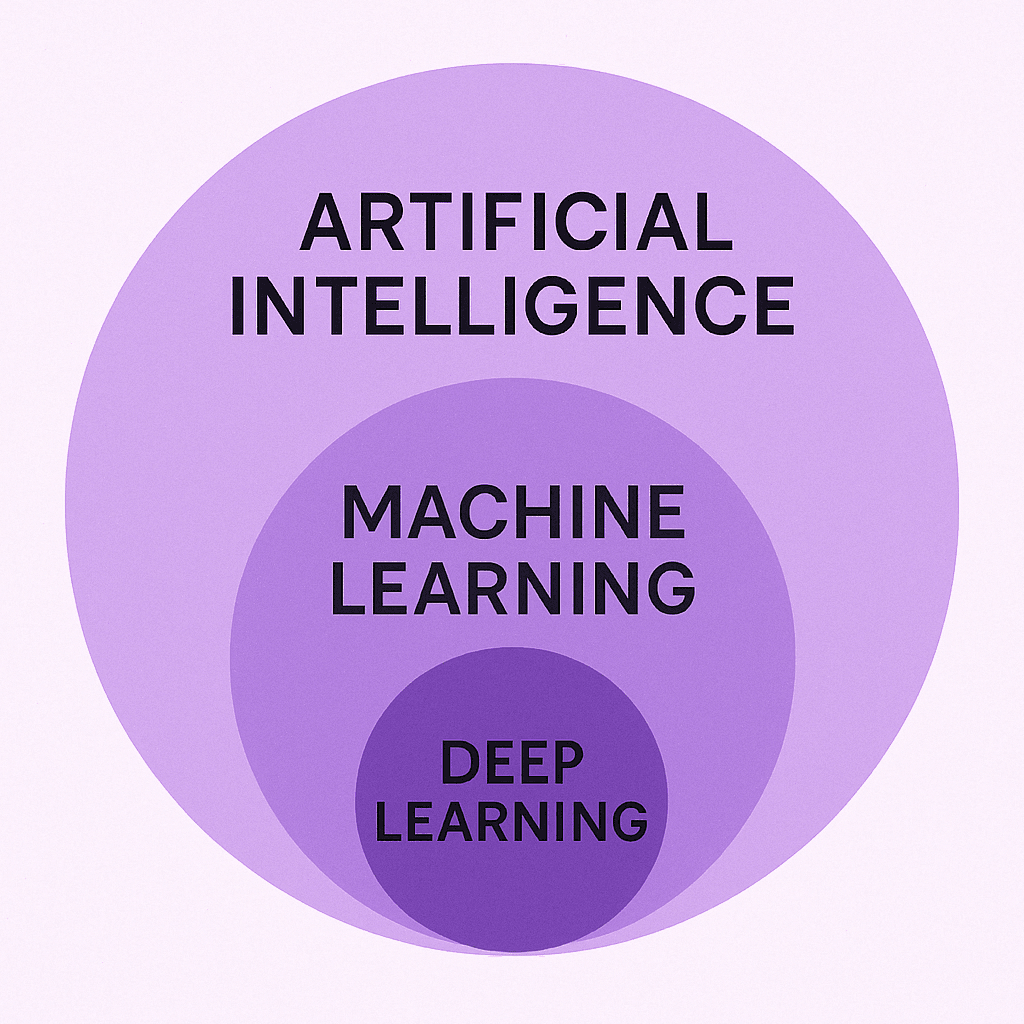
Artificial intelligence (AI) is a technology that lets computers and machines simulate human learning, understanding, problem solving, decision making, creativity, and autonomy. Think of it as an assistant that processes information much like a human does. The concept of AI isn't new, it goes back to the 1950s. The real boom came only in recent years, thanks to new models that greatly improved natural language understanding. The breakthrough came mainly from so-called large language models (LLMs). A typical example is ChatGPT.
Apple's Siri also uses elements of AI, and it has been around since 2011.
Machine learning
Machine learning is a field of artificial intelligence that lets computers learn from data without being programmed step by step.
Models learn to recognize patterns, relationships, and rules that aren't obvious in the data at first glance. They can then predict, classify, or decide on their own, even over new information they've never seen.
The goal is for them to get steadily better at what they do as more data comes in.
Deep learning
Deep learning is a type of machine learning that teaches AI to recognize patterns in data using neural networks, structures inspired by the human brain.
The more "layers" (neurons) a model has, the more complex things it can understand. Classical machine learning often gets by with smaller amounts of data and simpler algorithms, while deep learning needs larger datasets and more powerful computing.
LLM
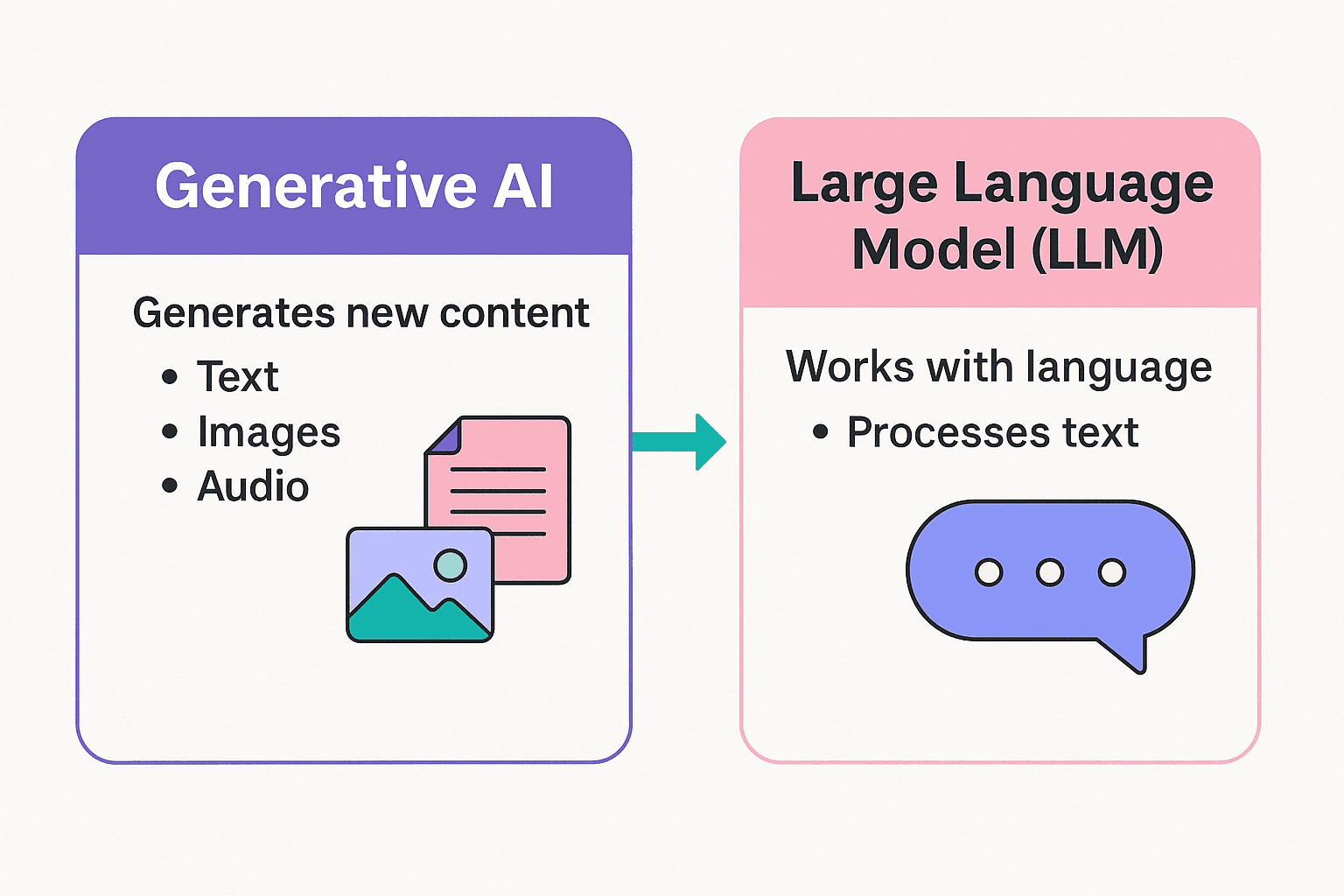
Large Language Model (LLM) is a form of artificial intelligence that specializes in working with language. It understands text and can write, summarize, translate, or answer questions. It learns from extensive analysis of language data available on the internet. LLMs are behind tools such as ChatGPT, Gemini, and Claude.
Chatbot
A chatbot is a program that communicates with people using text or voice. It usually helps with simple tasks: answering questions, making reservations, or handling customer support queries.
It used to work mainly from pre-written rules (for example, "if a user types A, answer B"). Today's chatbots use various forms of artificial intelligence, increasingly large language models (LLMs), so they respond more intelligently and naturally.
The important thing: chatbot ≠ AI. Most web chatbots still work without any AI.
Agent
An agent is a type of AI that can handle more complex tasks on its own, without you giving it each step individually. Just tell it the goal, and it plans the path there itself.
While a regular model like ChatGPT answers one specific prompt, an agent breaks the task into smaller parts, thinks about the process, and makes decisions across several steps. It suits more complex tasks, planning, and automation.
Tools that already work with agents include OpenAI Deep Research and advanced versions of ChatGPT.
Multi-agent
Multi-agent is a system where several AI agents work together at once. Each has its own task, but together they solve one larger problem. They work autonomously and still collaborate, much like a team of people.
In practice? A multi-agent system could plan a marketing campaign on its own: one agent researches the market, another writes the copy, and a third analyzes results and tunes the strategy in real time.
For now, only a handful of multi-agent systems run in production. Most haven't reached the level needed for extensive user testing. These are very complex systems.
Prompt
A prompt is the assignment you give an AI. It can be a question, a sentence, a task, or even a description of an image. With a prompt you're effectively saying: "This is what I want from you." Knowing how to prompt well is the key to a good result from AI.
Prompt engineering
Prompt engineering is the skill of instructing an AI correctly so the output is as accurate, practical, and meaningful as possible.
Prompt engineers craft cleverly worded inputs (prompts) so that AI tools work exactly as intended. For example, to write in the right tone, respond in context, or generate specific outputs.
Token
A token is the smallest unit of text the AI works with. It can be a whole word, part of a word, or even a punctuation mark.
The AI doesn't read text the way people do, it splits it into tokens. For example, the sentence "Hello world!" can be split into three tokens: "Hello", " world", and "!".
The number of tokens affects how much the AI can "read" or "generate" at once. The longer the input, the more tokens you use. With many AI tools you pay for the tokens you use, or your usage is capped.
Embedding
Embedding is how AI "translates" words and sentences into numbers (into vectors) that models understand and can work with.
Think of it as a map where the AI stores words with similar meaning close together. For example, "cat" and "dog" sit closer than "cat" and "table".
With embeddings, AI can search by meaning, compare texts, or recommend related content.
Context window
The context window is the amount of text the AI can "hold in its head" within a single task or conversation.
For example, the ChatGPT-4o model handles up to 128,000 tokens, roughly 300 pages of text. Older or simpler models handle only a few thousand tokens.
The larger the context window, the better the AI understands context, stays on topic, and responds consistently even on more complex tasks.
Fine-tuning
Fine-tuning is the process of "tweaking" an already pre-trained AI model for a specific purpose or type of data.
Think of it as retraining a generally smart model into a specialist. An AI that understands a bit of everything can, after fine-tuning, focus only on legal texts, customer support, or a specific brand tone.
You use it when you want the model to respond better to specific requirements.
Reasoning model
A reasoning model is a type of language model that doesn't just rely on what it has already "seen" in the training data. It can reason logically, plan steps, and solve problems.
While a regular model generates answers from similarities in text, a reasoning model works its way to the answer step by step, much like a person thinking through a complex problem.
Reasoning models include GPT 4o, Gemini 2.5 Pro, and DeepSeek R1.
Generative AI
Generative AI is a type of artificial intelligence that creates new content: text, images, sound, code, or video.
Unlike other models, such as predictive AI, which works with statistics or time series, generative AI creates something new based on what it learned from training data.
In practice it's often confused with LLMs. LLMs are one form of generative model, but generative AI is a broader term that also covers models for creating images, sounds, or video.
Deep research
Deep research is the ability of AI to find, sort, and evaluate information from different sources to give you the most accurate answer.
It's not just a quick answer to a question, but a thorough piece of research. You'll use it when writing technical texts, analyzing markets, or making strategic decisions. It pairs with tools that have access to current data on the internet (for example ChatGPT Deep Research, Perplexity.ai, or Consensus).
Benchmark
A benchmark is a standardized test that measures and compares the performance of AI models.
Models like ChatGPT, Claude, and Gemini are regularly tested on benchmarks such as MMLU (for general knowledge) or GPQA. The results often serve as a basis for picking the right tool.
Benchmarks help with orientation, but they often test only narrow skills. In real-world use, a model with a lower score may well perform better.
You can track how the individual models stack up here.
NLP
Natural Language Processing is a field of AI that deals with understanding human speech.
Thanks to NLP, AI can read, write, answer questions, or even pick up the tone of a message.
AGI
Artificial General Intelligence is a hypothetical type of AI that could handle any task as well as, or better than, a human.
AGI could invent a scientific theory on its own, settle a legal dispute, or run a company. It doesn't exist yet, but companies like OpenAI and Anthropic are working toward it.
RAG
Retrieval augmented generation is a way of connecting AI to external data. For example, to a company's current data, which it then uses to generate answers. That way it works with verified information, which makes it more accurate and reliable.
RAG is typically used for corporate chatbots that answer from internal documentation, or AI assistants that draw on current articles, contracts, or data.
CAG
Cache-Augmented Generation works by having the AI store important information in its "short-term memory" (the context window) in advance, so it can use it directly later. It reacts faster and stays on topic because it carries the knowledge it needs with it. Unlike other approaches, it doesn't search for information at the moment of the query, it already has it ready.
You'll see it in tools that repeatedly work with the same context, for example chatbots that handle multi-step tasks.
Conclusion
The world of AI changes incredibly fast, and with it the number of new terms you'll run into keeps growing. So in time we'll happily put together a version 2.0 (and maybe even 3.0).
We hope these terms now make more sense and come in handy in practice.
Related articles:
- Let's talk about AI: #1 The yin and yang of AI - Discover the benefits and potential drawbacks of AI, including its impact on healthcare, education, the tech industry, job displacement, and security risks.
- Let's talk about AI: #2 The Top 5 AI Tools for Technical Writers - Supercharge productivity: Jenni, Bearly, Fireflies, Synthesia, ChatGPT. Streamline writing, enhance efficiency, create videos, support language.
- Let's talk about AI: #3 AI-Powered Solutions for Real-World Challenges - The last piece in this series will examine how to use AI technologies to optimize performance on a variety of tasks.
- The Intersection of AI and Developer Experience - Artificial Intelligence (AI) has been making waves in various industries, and software development is no exception.
Want to stay one step ahead?
Don't miss our best insights. No spam, just practical analyses, invitations to exclusive events, and podcast summaries delivered straight to your inbox.