
Automatizace ušetřila 25 % času vývojářů
Revolgy
AI & Automatizace, Vývoj na míru
25% ušetřeného času
CI/CD optimalizace procesů
0 lidských chyb
Detail
AI & Automatizace, Vývoj na míru
Sales-side domain experts at a large Czech industrial enterprise used to retype every technical inquiry by hand: more than 30 parameters per item, up to five hours a week each. We built an AI assistant that splits an inquiry into items, fills in the parameters, and marks which values it is sure about. On 50 real inquiries it gets 99.1% of values right, and a human approves every item.
01
Reads inquiries in any shape
Emails, PDFs, scans, and phone photos in three languages. The system splits each document into line items and separates shared requirements from those that apply to only some items.
02
A dedicated extractor for each of 30+ parameters
Every parameter has its own definition, schema, and model call. A failure in one parameter cannot spill into the others, and accuracy is measured and tuned parameter by parameter.
03
Confidence we compute, not the model
Each value comes with a citation that we verify against the source text, and confidence is calculated deterministically. Values marked reliable are wrong 0.5% of the time.
04
Human approval built into the design
No item leaves without an expert's sign-off. Experts focus on the roughly 12% of values flagged as uncertain, then export the result to Excel in one click.
05
Corrections that become rules
A correction with a short rationale is stored as a general rule, and the system retrieves it on its own for similar future inquiries. No retraining involved.
06
Measurable quality and cost
A suite of 231 automated tests on real documents, plus a log of cost, latency, and confidence for every extraction. We see regressions before users do.
The sales department of a heavy-industry customer receives technical inquiries as free-text emails, PDFs, scanned documents, and photos taken on a phone. They arrive in three languages, and input quality varies: tables without borders, empty cells, blurred characters.
A domain expert had to retype every inquiry into an internal form: more than 30 parameters per item, from material designation and chemical composition through mechanical properties to tolerances, standards, and packaging. A typical inquiry has a header with shared requirements and a table of four to eight items. Some requirements apply to every item, others only to a few. Splitting the document into items was manual work, and that is where errors crept in.
Retyping had a second cost. Two experts would record the same inquiry differently, and downstream systems received inconsistent data.
The work took up to five hours a week per expert and sat between an inquiry arriving and a quote going out. Every hour of delay meant a later answer to the customer.
We built an AI assistant that processes an inquiry in the background and hands the expert a pre-filled form. The user uploads a document, can close the browser, and gets an email when the run finishes. The result takes four steps and is ready within minutes:
| Before | After |
|---|---|
| The expert reads the whole document and retypes 30+ parameters for every item. | The expert reviews a pre-filled form, confirming or correcting. |
| A mistake repeats until someone remembers it. | A correction immediately becomes a rule for future inquiries. |
| Output quality is not measured. | Every value has a numeric confidence; every run has a cost and duration in the dashboard. |
| The output table is assembled by hand. | Excel in one click. |
The system never releases a result without human approval. An item is done only when every extracted parameter is either confirmed by the expert or carries high confidence. An empty extraction cannot be approved at all. In heavy industry, a mistyped tolerance costs orders of magnitude more than a few seconds of review.
99.1% at the parameter level and 60% at the document level are both true statements about the same system. The first says how good the model is. The second says whether it can run without a human.
The gap between the two numbers is not a measurement error. More than 30 parameters times several items adds up to many chances for a single mistake. That is why we chose an assistant with calibrated confidence over full automation.
Skip this section if you only care about the impact.
Learning and operations follow the same logic:
We measure accuracy on an evaluation set of 50 real inquiries (104 items, 3,432 checked values). Two comparable runs three weeks apart, in May and June 2026, show how far the system moved:
The project ships with 231 automated tests on real documents. For every item they check all parameters, not just the expected ones, so a fabricated value counts as a failure automatically. An expert notices a missing value; a fabricated one they would have to hunt down.
For day-to-day work, whether the confidence score can be trusted matters more than average accuracy. Values from the June run, by confidence band and correctness:
| Confidence band | Values checked | Error rate |
|---|---|---|
| High | 420 | 0.5% |
| Medium | 2,598 | 0.4% |
| Low | 413 | 4.1% |
A value flagged as uncertain is wrong roughly nine times more often than one marked reliable. Experts therefore concentrate on the roughly 12% of values in the low band and confirm the rest. The medium band has a lower error rate than the high band because, for a number of parameters, we deliberately cap confidence below the threshold for confirmation-free approval. It is a conservative setting that we will tighten using production data.
Errors cluster by document. One badly scanned document with four items produces four errors in the same parameter. That is why we also track document-level success, and why the per-parameter error ranking doubles as a prioritized backlog.
For the sales department, work that used to take up to five hours a week now takes minutes of review, and answers reach customers within hours rather than days.
The next step is to skip review for any parameter whose reliable band holds an error rate below 2%. The system is already collecting the data to decide.
The same pattern transfers anywhere people retype unstructured input into a fixed schema: orders, complaints, technical specifications, tender documentation. Principles we carry forward from this project:
Revolgy
AI & Automatizace, Vývoj na míru
25% ušetřeného času
CI/CD optimalizace procesů
0 lidských chyb
Detail
Heureka Group
AI & Automatizace, Strategie & Školení
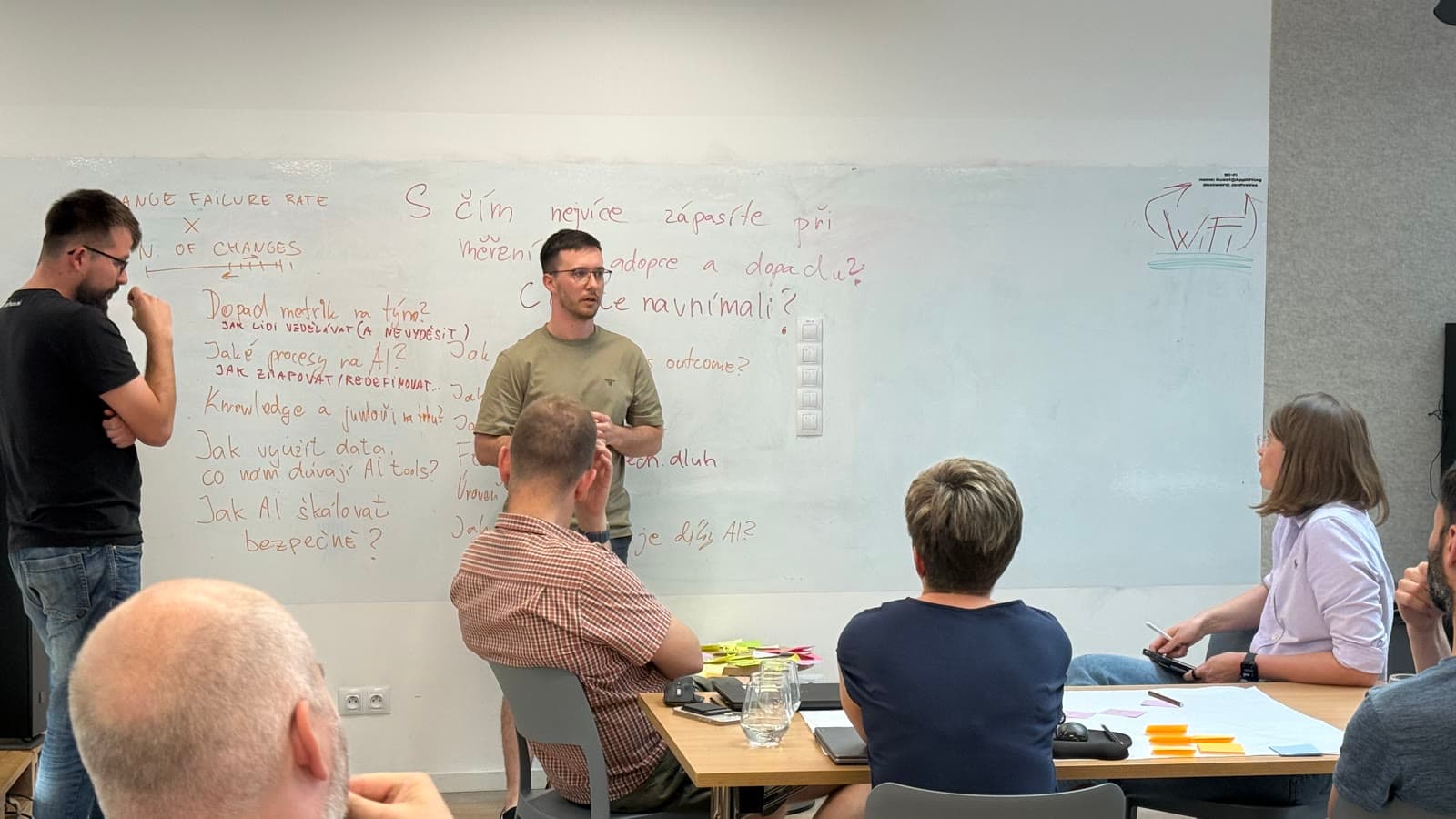
90%+ R&D používá AI nástroje
50% úspora času na klíčových úkolech
13 týmů za 3 měsíce
Detail