
Why We Built Plantory, and What It Taught Us About AI
Length:
6 min
Published:
April 22, 2026
There's a moment in most AI conversations with enterprise teams where somebody says "show me what you've actually shipped." It's a fair question. A slide deck of streaming chat demos and "AI strategy frameworks" doesn't answer it. So we stopped answering it with slides.
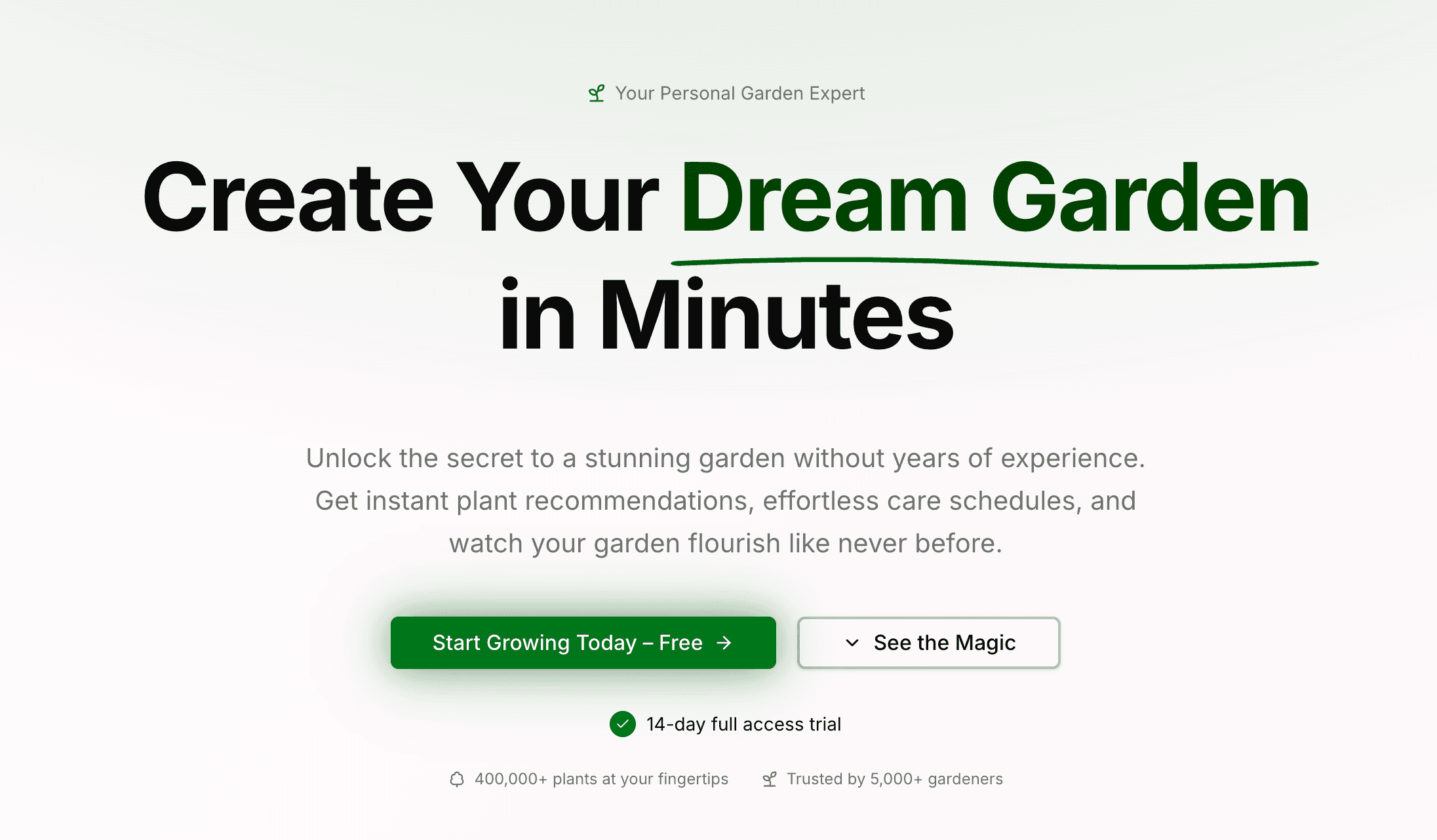
Plantory.ai is DX Heroes' in-house AI-native SaaS. It plans gardens for 5,000+ home gardeners across Europe. More importantly, it's our stake in the ground: a production system where the feature, the ad, the blog, and the build pipeline are all AI-driven. If we can't run our own AI product end-to-end, we have no business telling clients how to run theirs.
This is the story of why we built it, what surprised us, and how it changed how DX Heroes shows up for customers. For the full technical anatomy, see the Plantory.ai case study.
The itch
The AI boom of 2024–2025 turned everyone into a chatbot vendor. We kept running into the same pattern: clients asked for "AI", meant "magic", and got a floating text box somewhere in their product. A bolt-on.
But the interesting work wasn't in the chat box. It was in what happens when AI gets real context: a spatial model of a garden, a budget, a calendar, and an inventory. It was also in what happens when that context flows through every customer surface: the product itself, the ads that acquire users, the content that ranks us in search, and even the code agents that ship the features.
Nobody was building that out loud. So we did.
The bet
Home gardening was the right wedge. It has real physical constraints: climate, soil, and sun. It has real uncertainty: "will this even survive here?" It has a clear spatial object, the garden itself, that AI could actually see once we built a 2D canvas for it. And it has a global audience of hobbyists who would tell us, plainly, when the AI was wrong.
We set three rules early:
- Every customer-facing surface should be AI-produced. Not just the feature. The social post. The SEO page. The onboarding email. The ad variant. The blog.
- Every AI call gets context. No loose prompts. The garden model is always there.
- We run it ourselves in production. Not a demo repo. Real Stripe. Real Meta Ads budget. Real Czech, English, German, Spanish, French, Italian, Polish, Slovak content.
Six months later, those rules produced 15+ AI pipelines in production, 8 locales, 5,000+ users, and a real P&L that pressure-tests every decision.
The first hard truths
Shipping an AI-native SaaS immediately strips away the things you can get away with in demos.
Context is 90% of the work. The Gemini advisor only feels smart because the canvas is the source of truth. Without real coordinates, climate zone, soil, and plant inventory, the same model gives the same platitudes you'd get from a generic chatbot. The prompt is not the hard part; the grounding is.
Media pipelines compound. Once we had Satori + Resvg + Gemini producing social images automatically, we suddenly had too many channels to fill manually. That forced us to build a content calendar, a review gate, and an eight-locale publishing pipeline. Automation exposes the workflow debt you didn't know you had.
Ad-platform automation is where "AI-powered marketing" either graduates or dies. We deploy to Meta Ads and Google Ads programmatically. AI writes the variants, sets the budgets, and launches the flights. But without cost controls, evals, and a human on strategy, you can burn through a month's budget in an afternoon. We learned this the hard way.
A plugin beats a prompt. The biggest unlock wasn't a clever prompt. It was building our own Claude Code plugin marketplace. The plantory plugin ships 20+ skills: /plantory:spec-plan, /plantory:board-work, /plantory:blog-article, /plantory:paid-performance-review. Each one packages a workflow we used to do ad hoc. AI coding is a lot less magic and a lot more engineering once you stop hoping it'll figure it out.
What it changed about DX Heroes
Three things shifted in how we show up for customers.
First, the advice got sharper. When a CMO asks "can AI write our ads?" we don't answer in the abstract. We have a library of Meta and Google Ads creative that AI produced, a dashboard of what worked, and a list of the three things that actually matter: context, evals, and budget caps.
Second, the demos got real. Every pattern we bring to an engagement is something we run ourselves: streaming AI endpoints, structured output, multimodal vision, cost controls, programmatic ad deployment, content pipelines, and plugin-based AI dev workflows. That's not a slide. It's a repository with commits, a billing account with charges, and a production error budget.
Third, the bar went up. You can't help an enterprise become AI-native while watching from the sidelines. The team learned what breaks at scale. The feedback loop is tighter.
The playbook we ended up with
If I had to compress it into one line: ship to paying users, or you're bluffing.
The more practical version is four layers, each fully AI-driven:
- The product: advisor, recognition, task generation, visualizations
- The media: AI-generated social, video, SEO, article covers
- The distribution: programmatic ad deployment to Meta and Google
- The build: Claude Code plugin marketplace, spec-driven AI development
We wrote two companion pieces that go deeper on each:
- The AI-Native SaaS Playbook: architecture, tools, trade-offs
- Seven Lessons Plantory Taught Us About AI in Production
And for the full Plantory case study, with metrics and the seven-pillar breakdown, see the Plantory.ai case study.
Why this matters
You will hear "AI-first" from many companies this year. Most of them mean "we put a chatbot on the landing page." That's not the same thing.
AI-native means the AI is in the feature, the ad, the page, the pixel, and the commit. It means you've made the bet yourself, paid for it, and have the evidence to show. We have.
If that's the kind of AI partner you want, come talk to us. If you just want a deck, someone else will happily sell you one.
Want to stay one step ahead?
Don't miss our best insights. No spam, just practical analyses, invitations to exclusive events, and podcast summaries delivered straight to your inbox.